
NEWS
多文化コミュニケーション学科
Sustaina Talks 2026: Student Voices Advancing SDG 4 Through English Education
- 2026.05.8
- 多文化コミュニケーション学科
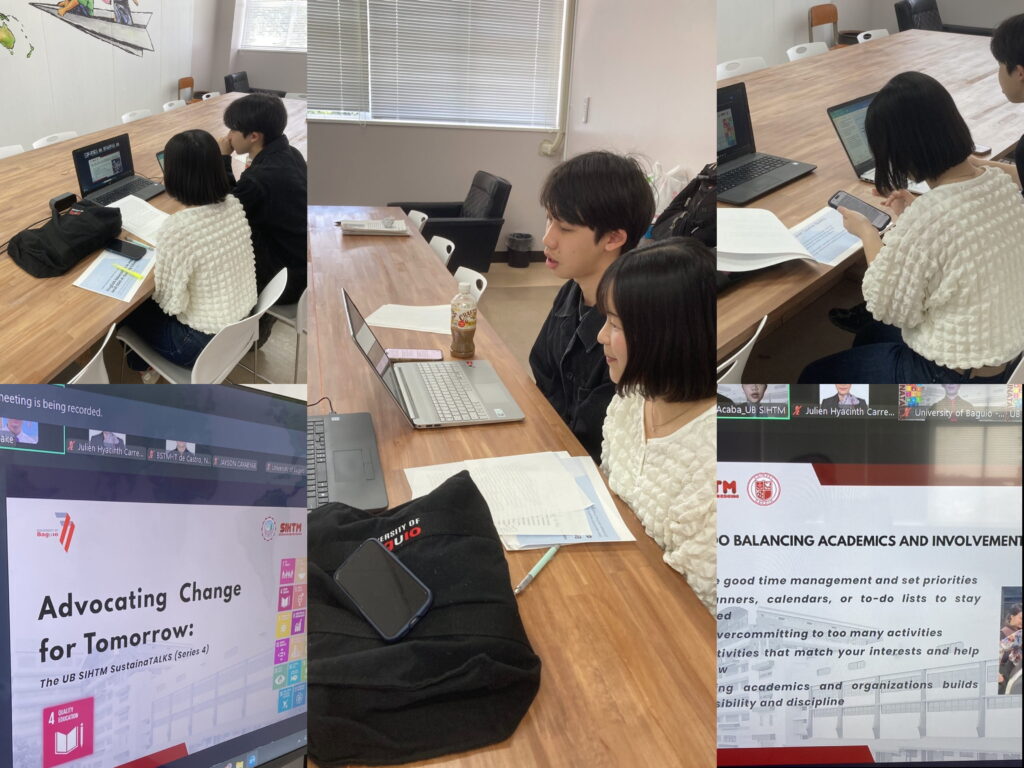
On May 8, 2026, Nagasaki Wesleyan University participated in the Sustaina Talks symposium hosted by the University of Baguio, bringing together students and faculty in a shared dialogue on SDG 4: Quality Education. The event highlighted the importance of cross-cultural exchange in addressing global educational challenges and fostering mutual understanding.
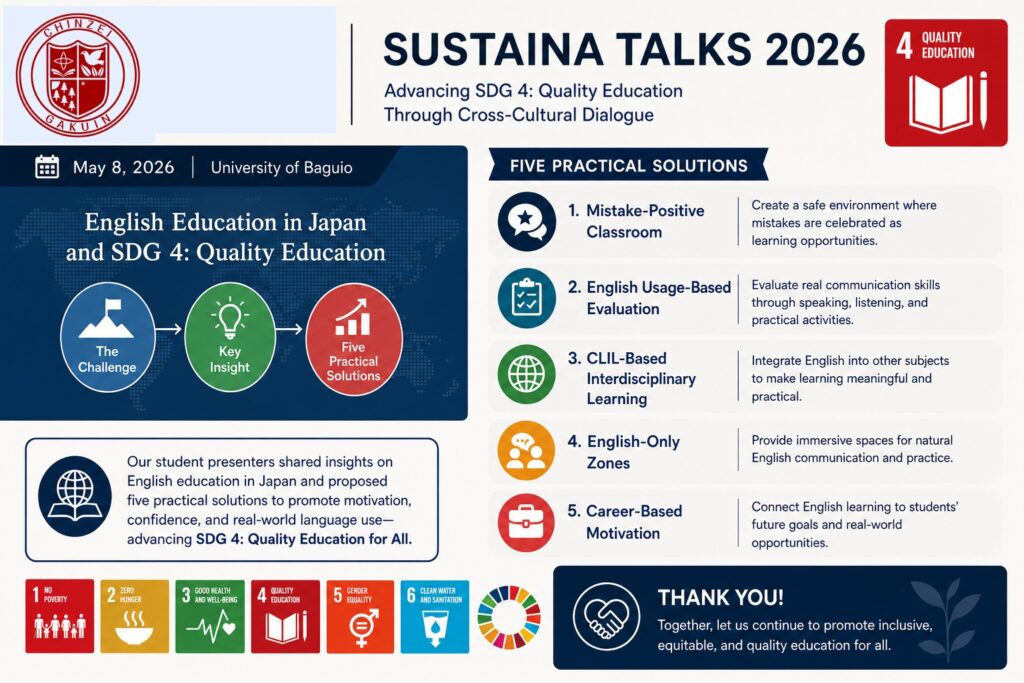
Representing the university, student presenters K. Hayashida and M. Ikeda delivered a thoughtful and engaging presentation titled “English Education in Japan and SDG 4: Five Solutions.” Their talk explored both the strengths and challenges of English education in Japan while proposing practical strategies for improvement aligned with the goals of inclusive and equitable education.
The presentation began by outlining key features of Japan’s education system, including a nationally standardized curriculum, strong teacher development practices, and structured evaluation systems. These elements contribute to consistent academic outcomes and support overall educational quality. At the same time, the students reflected critically on a central issue: despite years of study, many learners struggle to achieve fluency in English.
A key insight emphasized throughout the presentation was the role of student motivation and confidence. Drawing from both research and personal experience, the presenters noted that students who feel confident in their abilities are more likely to engage actively in learning, while those who lack confidence often fall into a cycle of disengagement. This perspective aligns closely with SDG 4’s broader focus on not only access to education but also meaningful and effective learning experiences.
M. Ikeda further enriched the discussion by sharing his study abroad experience in Canada, illustrating how a supportive and immersive learning environment can significantly enhance language confidence and communication skills. This personal reflection provided a powerful example of how educational contexts can shape student outcomes.
Building on these insights, the students introduced five practical solutions to improve English education in Japan:
- Creating “mistake-positive” classrooms where students feel safe to take risks and learn from errors
- Shifting toward usage-based evaluation that prioritizes real communication skills
- Implementing CLIL (Content and Language Integrated Learning) approaches to connect language with meaningful content
- Establishing English-only zones to encourage immersive practice in everyday settings
- Promoting career-based motivation by linking English learning to students’ future goals
These proposals highlighted the need to move beyond test-centered approaches and toward more holistic, student-centered learning environments.
The presentation concluded with a clear message: achieving SDG 4 requires not only structural strength in education systems but also a transformation in how learning is experienced by students. By fostering motivation, confidence, and real-world application, educators can create more inclusive and effective pathways for language learning.
The Sustaina Talks symposium served as a valuable platform for dialogue and collaboration, reinforcing the importance of international partnerships in advancing the Sustainable Development Goals. Through their participation, Nagasaki Wesleyan University students demonstrated the power of student-led perspectives in contributing to global conversations on education.